
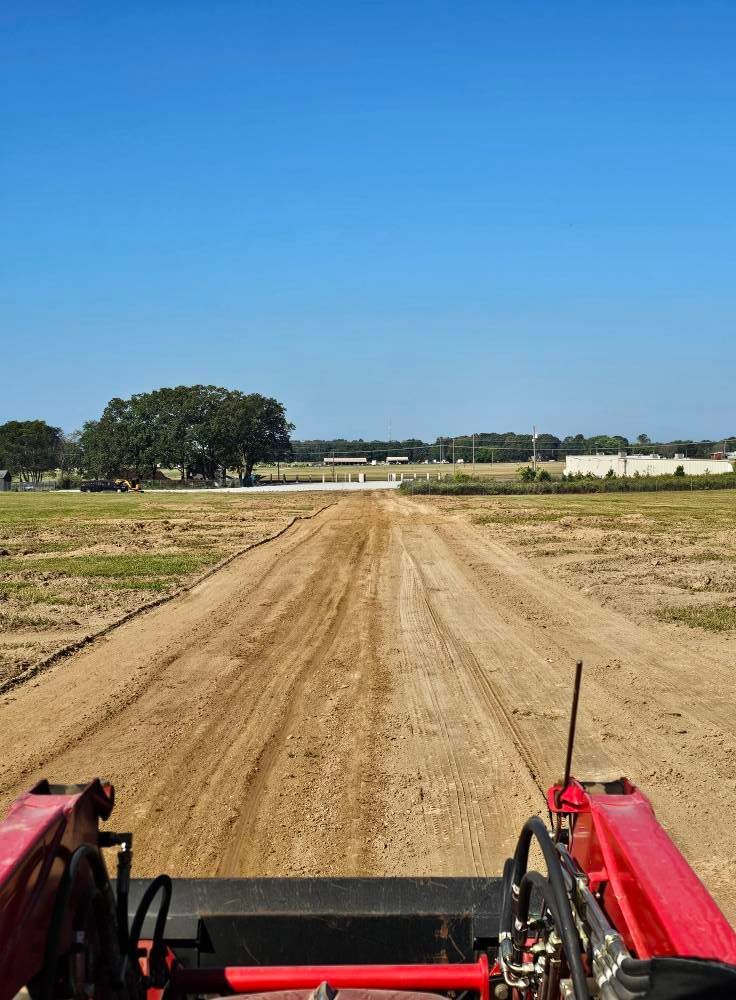
Final Preparation for Seeding and Construction
Finish Grading in Florence for agricultural seedbed preparation and building site completion
Peters Farms & Equipment co. handles finish grading work that prepares land for seeding, building construction, or equipment operation after initial earthwork and drainage installation are complete. This final land preparation smooths the surface to specifications that allow seed-to-soil contact for germination, create level pads for building foundations, or establish access routes that support loaded farm equipment without rutting. Alabama clay soil requires specialized finish techniques because the material compacts differently than sandy loam, affecting both drainage stability and surface smoothness.
The finish grading process involves fine-tuning surface elevations within fractions of an inch, removing debris that interferes with planting or construction equipment, and establishing final slopes that match drainage plans. Precision equipment spreads and levels topsoil for seedbeds or compacts subgrade for foundations, depending on whether the site will support crops or structures.
Contact Peters Farms & Equipment co. to review finish grading specifications for your agricultural or construction project.
What Finish Grading Actually Accomplishes
Work starts after rough grading establishes general contours and drainage patterns, focusing on the top few inches of soil that directly affect planting success or construction performance. Finish blades and box scrapers smooth the surface, removing ruts and ridges while maintaining the underlying drainage slopes created during rough grading. For agricultural seedbeds, topsoil is spread uniformly and worked to a texture that allows seed placement at consistent depths, which determines germination rates and crop establishment.
After finish grading, the land surface will be smooth enough that planting equipment maintains uniform seed depth without bouncing over rough spots or digging into depressions. Building pads will be level within tolerances that foundation contractors require, with compacted subgrade that supports structural loads without settling. Farm access routes will be firm and even, allowing equipment to cross without creating ruts that trap water or damage machinery. The final surface matches project specifications rather than showing the irregular contours that remain after rough earthwork.
Agricultural finish grading accounts for farm equipment dimensions and weight, creating surfaces that heavy tractors and combines can traverse without soil displacement. Understanding farming operation needs means finish work considers where equipment will turn, how heavily loaded implements will bear on the soil, and whether the surface will support traffic during less-than-ideal weather conditions when work cannot wait.
Questions Before Starting Your Project
Property owners preparing land for planting or construction in Florence typically ask about surface tolerances, timing considerations, and how clay soil characteristics affect finish grading results.
What is the difference between rough grading and finish grading?
Rough grading establishes general slopes and removes or adds large volumes of soil to create proper drainage and site elevations. Finish grading refines the surface to precise specifications, smoothing the top layer for immediate use without further soil work.
How smooth does finish grading make the land surface?
Agricultural seedbeds are finished to allow planting equipment to operate without depth variation, typically within one to two inches of target elevation. Building pads meet tighter tolerances specified by foundation contractors, often within half an inch across the pad area.
Can finish grading be done immediately after rough grading in Alabama clay?
Finish work proceeds weather permitting because clay soil must be at proper moisture content for effective smoothing and compaction. Soil that is too wet smears rather than levels, while overly dry clay resists blade action and compacts poorly.
What equipment is used for agricultural finish grading?
Box scrapers, finish blades, and land planes smooth soil to specifications while maintaining underlying drainage slopes. Precision equipment handles the fine adjustments needed for seedbed preparation, where small elevation errors affect planting depth and crop emergence.
Does finish grading include removing rocks and debris from the surface?
Finish work clears stones, roots, and construction debris that would interfere with planting equipment or building construction. The surface is left clean and ready for immediate use without requiring additional preparation by the property owner.
Peters Farms & Equipment co. specializes in agricultural finish grading where understanding farm equipment access needs and clay soil behavior determines whether land is truly ready for planting or construction. Arrange a site consultation to discuss finish grading methods and equipment selection for your specific project requirements.